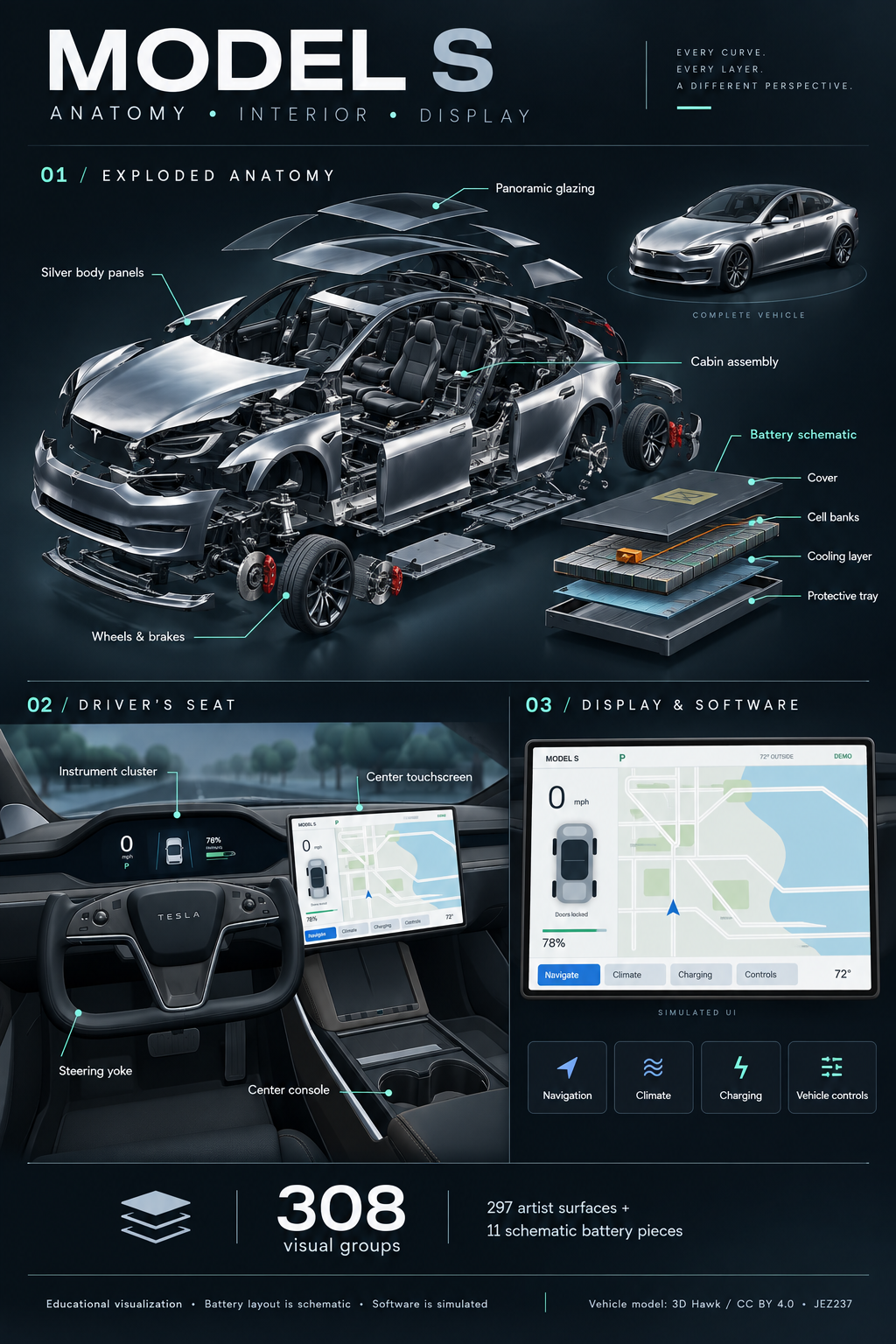
Your guide to the interactive studio, the added battery anatomy, and the vehicle systems behind the silhouette. Official Tesla documentation is linked directly wherever vehicle specifications or operating information are discussed.
The guided tour follows nine stops from the exterior and schematic battery to the cabin and touchscreen. Use Next, Back, or the stop menu; Play advances every 10 seconds. Interacting with the scene or leaving the tab pauses playback. In the interior, choose Seats & stitching, Door trim, Pedals & footwell, or Center console for a close-up. Drag to inspect, then return with Driver’s seat.
See every part together
Choose All parts on screen. All 308 selectable pieces receive individual, non-overlapping spaces. The board includes 297 artist surfaces and 11 added schematic battery pieces. Each piece is scaled independently for visibility; this layout is not to a common engineering scale. Use Fit every part to restore the complete arrangement after zooming.
Explore the assembled car
Drag with one finger or the left mouse button to orbit. Use the wheel or a two-finger pinch to zoom. Use right-drag to pan. Perspective, Side, Front and Top provide quick camera positions. Auto orbit starts a slow rotation only when you request it.
Explode and reassemble
Move the explosion slider from 0 to 100, or press Explode model. Panels, glazing, cabin surfaces and wheels separate in space; the added battery moves out from beneath the floor. This spatial view can contain overlap from some angles. The all-parts board provides the unobstructed alternative. Reassemble restores the original placements.
Inspect a piece
Click a surface or select it from the searchable component list. The inspector displays its visual category, approximate model bounds and triangle count. Isolate piece removes surrounding geometry and moves in for a close-up. On the board, isolation gives that piece its own larger space. Clear restores the current system view.
Look inside the battery
Choose Battery anatomy for a close-up of the added pack layers. The tray, cooling plate, five illustrative cell banks, rail, cover, connector and electronics housing are separately selectable. In Visible system, choose Battery to filter either layout to these eleven pieces.
Reset, playback and accessibility
E toggles explosion; R resets assembly, camera and filters; Escape clears selection. Paint is retained on reset. Play sequence runs an explode, hold and reassemble cycle. Reduced-motion preferences disable transition easing. On phones, zoom the parts board or use fullscreen when individual pieces are small.
The driver’s-seat studio places the camera inside the same artist model. Drag to look around without leaving the seat, scroll or pinch to change the field of view, or use the four preset views. Arrow keys look around when the viewer is focused; R returns to the driver’s seat. Close-ups show the yoke, instruments, center display and console.
Use the center display
Click controls directly on the 3D display, or choose Open touchscreen for a larger view. Navigation, Climate, Charging and Controls also open from the side panel. The enlarged interface supports keyboard focus. Escape closes it. On a narrow phone, swipe horizontally within the enlarged display to reach all controls.
Try the software study
Preview one of three fictional routes. Adjust temperature, fan speed, A/C and seat heat. Start an accelerated charging demonstration, change the charge limit or reset the sample battery. Toggle door-lock status, headlight mode, display brightness and day/night appearance. Instrument readings and the 3D display stay synchronized; the car remains parked.
See the cabin respond
Night appearance dims the cabin and illuminates the screens. The Climate page makes vent airflow visible, with its animation responding to fan speed. Reduced-motion mode holds the airflow still and changes viewpoints immediately. Yoke markings and screen graphics are added visual interpretations.
Understand the scope
This is an original interactive interface study inspired by documented Model S functions. It is not Tesla firmware, an exact software-version replica, a driving simulator or a connection to a real car. Routes, battery readings and charging speed are illustrative. The underlying artist geometry supplies the cockpit shape.
The model is attributed by its artist as a 2021 Model S Plaid. Tesla’s current North American manual covers 2021+ vehicles and is updated with software and equipment changes. Match the documentation to your car’s configuration; a current feature or specification is not necessarily present on every 2021 vehicle.
Phone keys use Bluetooth. Key cards provide another way to authenticate; unlike a phone key, a key card does not offer automatic walk-away locking. Equipment and regional availability vary.
Review the official instructions for powering up, authentication and gear selection. The touchscreen and alternative shift controls depend on vehicle configuration.
Use Tesla’s charging instructions for the charge port, charging status, limits and connector handling. The battery information chapter explains storage and energy use.
The air suspension chapter describes ride-height behavior. The maintenance schedule and tire guidance provide the relevant vehicle care information. The studio’s animated disassembly is not a repair sequence.
The following figures are from Tesla’s current 2021+ North American manual, checked September 12, 2026. They are a reference for the vehicle family, not measurements taken from this artist model or a guarantee of any specific car’s equipment.
System
Tesla manual reference
Plaid drive arrangement
One front motor and two rear motors; liquid-cooled permanent-magnet synchronous motors with carbon-fiber-wrapped rotors.
Plaid gearing
Single-speed reduction; the manual lists 7.56:1 at the front and rear.
Front suspension
Independent double wishbone; air spring, adaptive damper and stabilizer bar.
Rear suspension
Independent multi-link; air spring, adaptive damper and stabilizer bar.
High-voltage battery
Liquid-cooled lithium-ion; nominal voltage listed as 407 V DC. Voltage is not battery capacity.
Steering
Variable-ratio rack and pinion with speed-sensitive electric assistance.
Source: Tesla — Subsystems. Pack capacity, exact cell count, usable energy and model-year-specific performance are not inferred from this visualization.
Dimension / equipment
Published reference
Plaid length
5,046 mm / 198.7 in in the current manual.
Width
1,987 mm without mirrors; 2,189 mm including mirrors.
Wheelbase
2,960 mm / 116.5 in.
Height at medium suspension setting
1,430 mm / 56.3 in.
Factory wheel sizes listed
19-inch and 21-inch; fitments vary.
19-inch tire reference, U.S. / Canada
255/45R19 front; 285/40R19 rear.
21-inch all-season reference, U.S. / Canada
265/35R21 front; 295/30R21 rear.
Sources: Tesla — Dimensions and Wheels and Tires. Tesla describes dimensions as approximate and configuration-dependent. Use the vehicle’s tire label for pressure and fitted tire information.
04 / THE ADDED BATTERY ASSEMBLY
The floor has a story, too.
The original downloadable car asset contains no high-voltage battery. This studio adds an underfloor pack so the exploded view can explain where stored energy lives in an electric vehicle. The extra pieces are always identified as schematic in the inspector.
This is an educational reconstruction, not Tesla CAD. The five drawn cell banks, their visible cell caps, dimensions, cooling plate and interconnection rail are illustrative. They do not establish the real module count, capacity, cell count, circuit design or service procedure. Do not use the animation as instructions for opening or servicing a high-voltage pack.
Enclosure and lid
A lower tray and a sealed cover enclose the illustrated pack. Their broad, flat shape places the assembly underneath the cabin. In the spatial exploded view, the pack moves beside the car to remain visible above the presentation platform.
Thermal layer
A blue-gray plate represents heat transfer to a liquid cooling circuit. Tesla confirms liquid cooling; this drawing does not reproduce the production channel paths.
Cell banks and connections
Five illustrative banks contain repeated cylinder caps to make the packaging legible. The connection rail, orange connector and electronics housing show general functions while avoiding a claim of exact electrical architecture.
What the numbers mean
The studio now has 308 selectable pieces: 297 reconstructed artist surfaces plus 11 schematic battery pieces. The count is a count of visual groups. The all-parts board scales them independently; inspector dimensions describe their modeled bounds only.
The model uses metallic silver clearcoat, patterned rubber, fine upholstery grain, carbon-style weave, brushed metal and tinted glazing. A purpose-built softbox environment provides continuous reflections across the body. Geometry simplification has been disabled to retain the available source detail. The lighting and finishes are visual interpretations.
Vehicle asset: Tesla Model S Plaid 2021 by 3D Hawk, CC BY 4.0. Adaptations include geometry regrouping, compression, materials and the separately identified battery reconstruction. This is an independent project with no Tesla affiliation.