The Hidden Reef - Aquariums, Fish, Coral, Ponds The Hidden ReefAquariums · Fish · Coral · Ponds
Help Center

Start smarter, fix problems faster.

Practical care guides for choosing equipment, understanding water quality, and troubleshooting the problems you actually run into at home.

Choose a Learning Path

New setup

Start a Tank

Step-by-step guidance for setting up a healthy, thriving aquarium.

Start here

Diagnosis

Fix a Problem

Find solutions to common issues and get your tank back on track.

Start triage
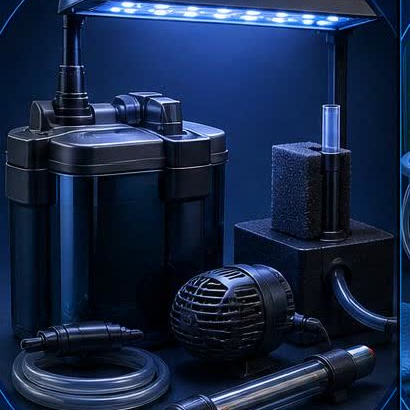
Gear help

Equipment

Compare filters, pumps, heaters, lighting, and more to find what's right.

Explore gear
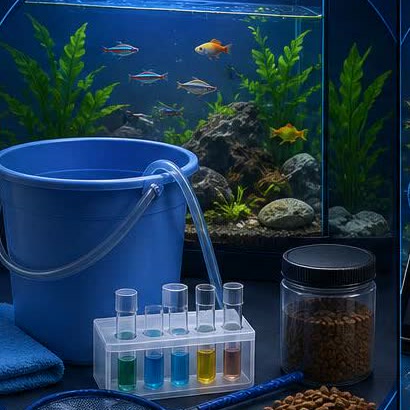
Routine care

Care Guides

Weekly routines, water changes, feeding, testing, and quarantine basics.

Feeding basics
Library

All Topics

Browse every guide and resource in one complete library.

Browse all

What Is Happening In Your Tank?

Start with the symptom, then move to tests, likely causes, and the safest first action.

Use this first

Bring the problem down to one next step.

Most aquarium issues look similar at first. Water trouble, oxygen trouble, disease, overfeeding, light, and dirty filtration can overlap. The goal is to check the urgent basics before buying treatments.

Fish at surface

Breathing hard or crowding the top

Treat oxygen, ammonia, nitrite, temperature, and recent chemical additions as urgent.

Start here
Water changed

Cloudy, green, milky, or smelly water

Separate bacterial bloom, green-water algae, excess food, dirty substrate, and decay.

Compare causes
Fish look sick

White spots, flashing, clamped fins, or hiding

Check water first, then separate parasites, stress, injury, and treatment safety.

Diagnose symptoms
Growth problem

Algae, mats, hair algae, or green water

Look at light schedule, nutrient fuel, flow, filtration, and whether UV makes sense.

Identify algae
First check

Start with oxygen and water quality.

Increase surface movement, then test ammonia, nitrite, pH, and temperature before adding medication.

Test first
    Do today
      Avoid
        Bring this in

        Store visit checklist

        Good notes make the conversation faster and keep the first fix safer.

          Explore Our Guide Library

          Expand a category to see what's inside.

          Starter & Care Checklists

          Choose the guide you need, then open the full page or supporting section.

          Freshwater start

          First Tank Checklist

          The full beginner setup guide: first shopping trip, equipment, water prep, cycling, and first livestock.

          Open guide
          Reef start

          Saltwater Setup Basics

          Start with the core saltwater plan: prepared water or RO/DI, salinity tools, flow, rock, sand, and testing.

          Open guide
          Routine care

          Weekly Maintenance

          A simple weekly rhythm for testing, water changes, glass cleaning, filter checks, and catching problems early.

          Open guide
          Daily care

          Feeding Basics

          Portion size, food rotation, warning signs of overfeeding, and how to match food to the fish in the tank.

          Open guide

          Filtration & Equipment

          One consolidated filtration area for freshwater, planted displays, saltwater, reef systems, UV, reactors, skimmers, and sumps.

          Freshwater & General

          Click a filtration system to open its diagram, use case, and maintenance notes.

          Compact filter Internal Power Filter

          Best for compact tanks where the filter sits inside the aquarium and keeps equipment out of sight behind plants or hardscape.
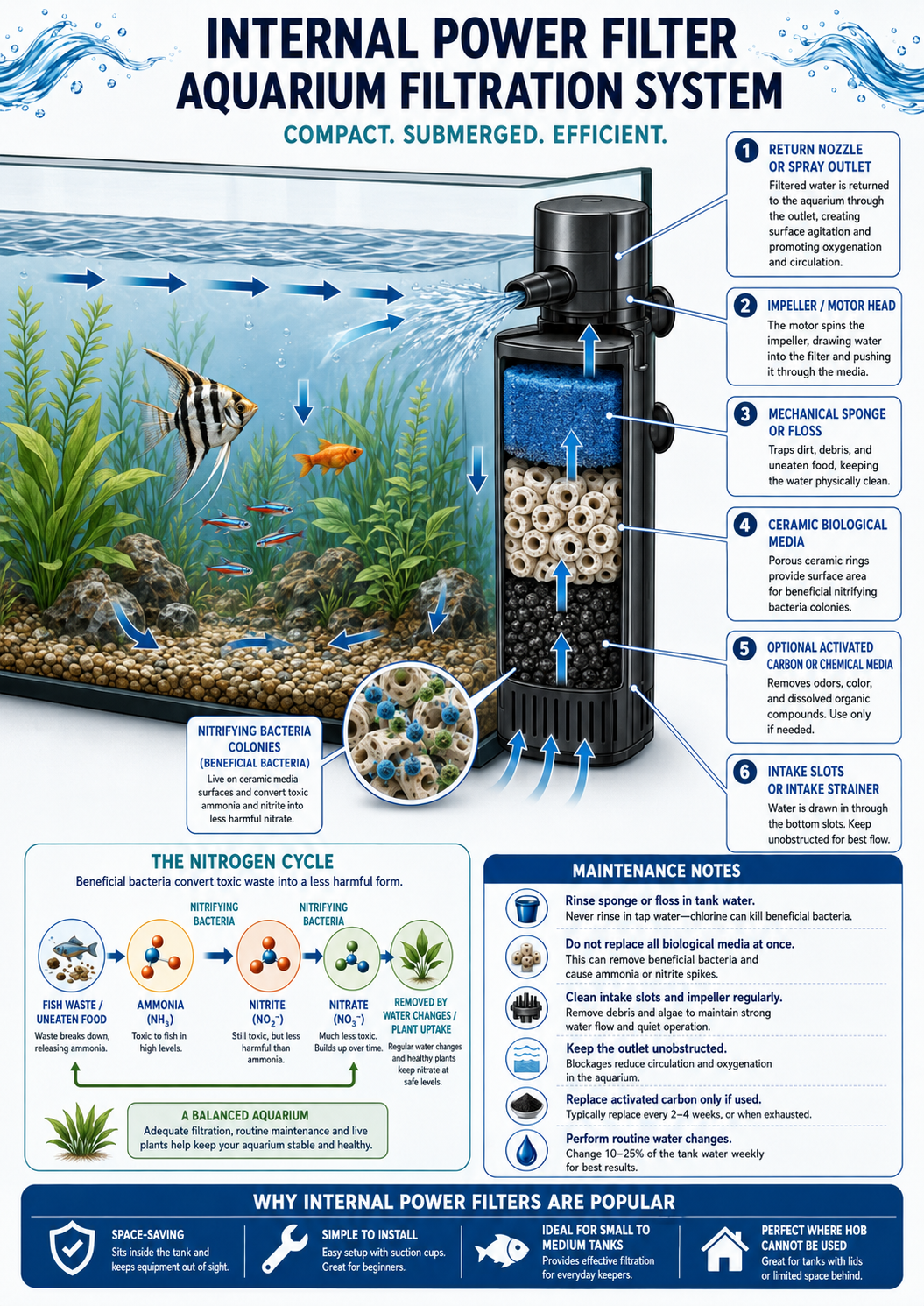
          Internal power filter aquarium filtration system diagram Click to enlarge

          Internal Power Filter

          Best for compact tanks where the filter sits inside the aquarium and keeps equipment out of sight behind plants or hardscape.

          • Good beginner visual for mechanical, biological, and optional chemical filtration.
          • Pairs naturally with filter media, replacement sponges, cartridges, and water conditioners.
          • Maintenance message is strong: rinse sponge in tank water and do not replace all biological media at once.
          Gentle biological filter Sponge Filter

          Best for low-flow tanks, fry, shrimp, quarantine systems, and simple biological filtration powered by an air pump.
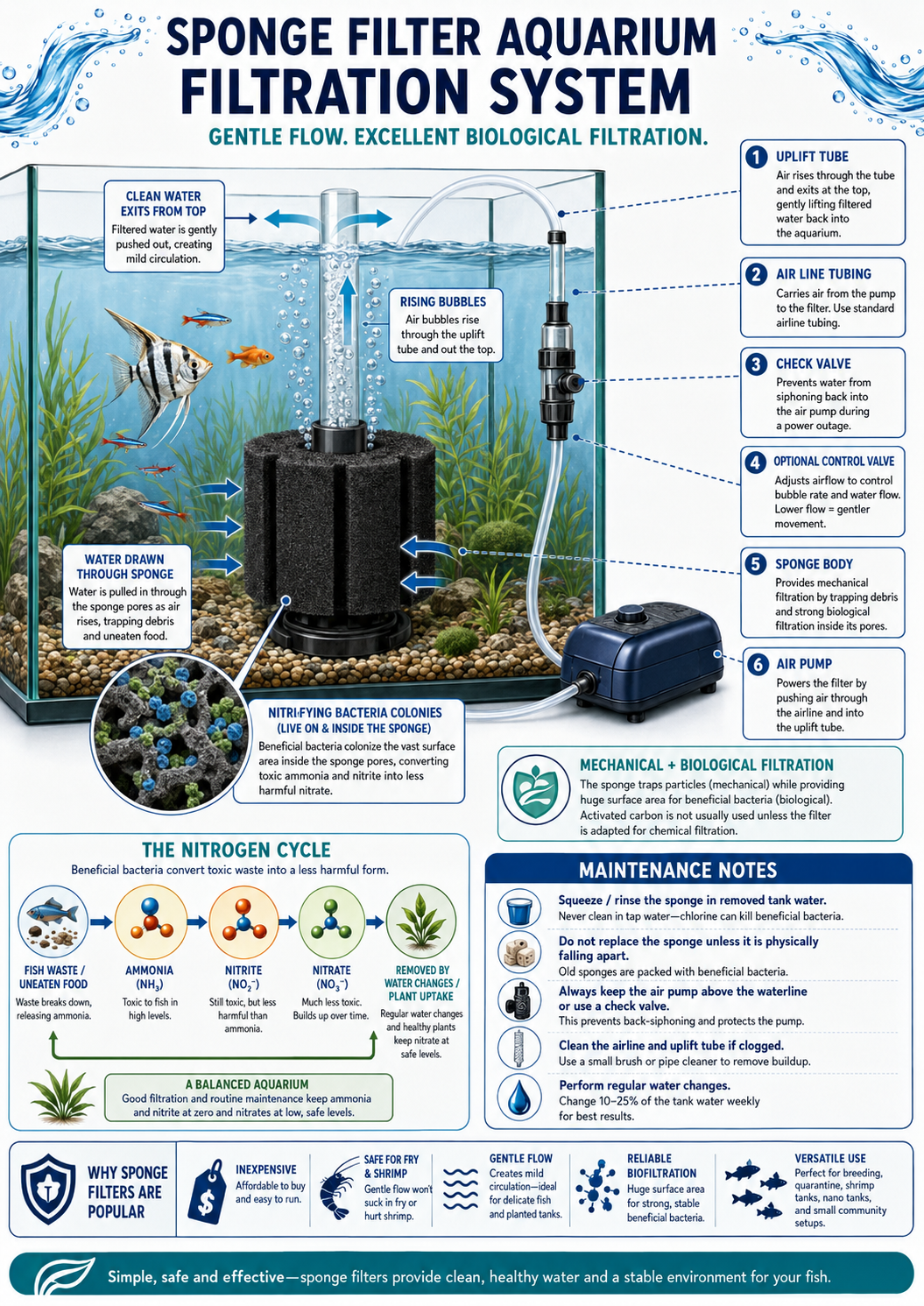
          Sponge filter aquarium filtration system diagram Click to enlarge

          Sponge Filter

          Best for low-flow tanks, fry, shrimp, quarantine systems, and simple biological filtration powered by an air pump.

          • Shows why the air pump, check valve, airline, uplift tube, and sponge all matter.
          • Clear path for choosing air pumps, valves, tubing, replacement sponge, and brushes.
          • Useful beginner note: old sponges are beneficial bacteria colonies, not trash.
          External filter Canister Filter

          Best when you want to understand an external canister system: intake, media layers, return flow, and routine maintenance.
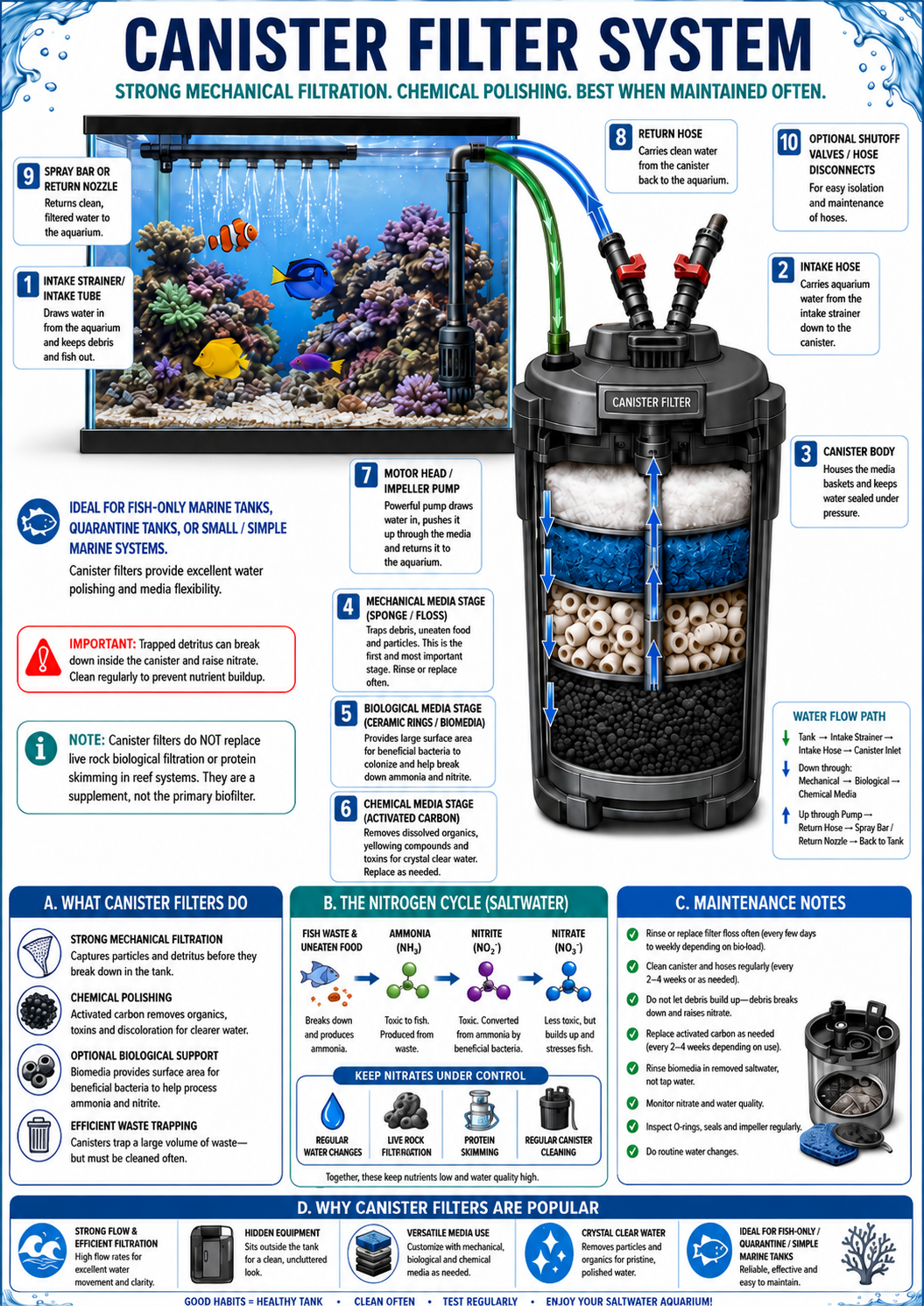
          Canister aquarium filtration system diagram Click to enlarge

          Canister Filter

          Best when you want to understand an external canister system: intake, media layers, return flow, and routine maintenance.

          • Good bridge between simple internal filters and larger external filter systems.
          • Clear path for choosing sponge media, ceramic rings, activated carbon, replacement parts, and impeller cleaning tools.
          • Strong maintenance note: preserve biological media and keep water changes part of the routine.
          Easy all-around filter Hang-On-Back Filter

          Best for small to medium freshwater tanks when you want simple setup, easy access, and visible waterfall return flow.
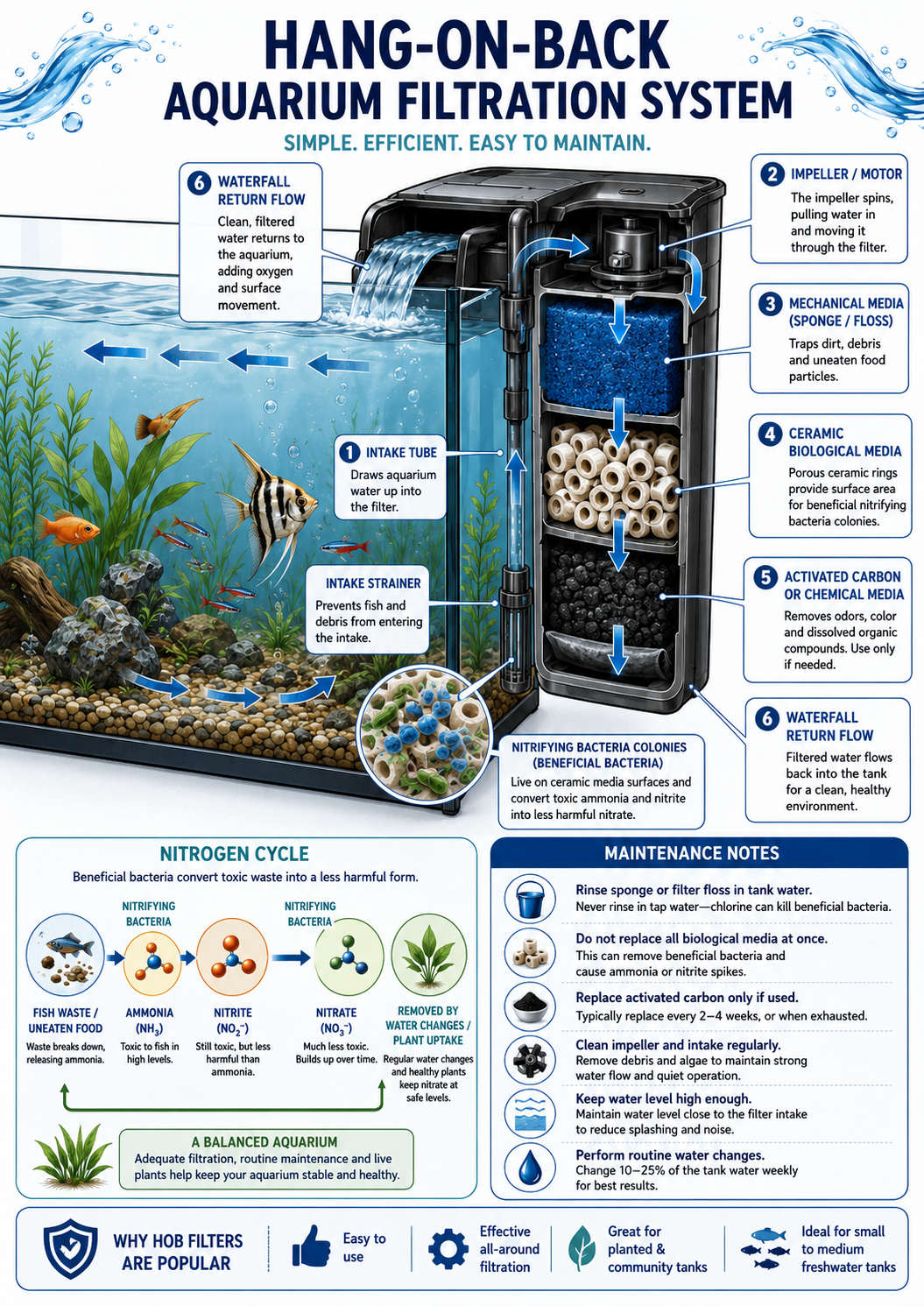
          Hang-on-back aquarium filtration system diagram Click to enlarge

          Hang-On-Back Filter

          Best for small to medium freshwater tanks when you want simple setup, easy access, and visible waterfall return flow.

          • Shows exactly why intake strainers, impellers, media order, and water level matter.
          • Natural fit for cartridge/media replacement, intake sponges, carbon, ceramic media, and flow troubleshooting.
          • Useful explanation for reducing noise, keeping flow strong, and avoiding tap-water media rinses.
          High-capacity system Sump Filtration

          Best for larger freshwater planted tanks, high bioload displays, reef tanks, and systems that need room for pumps, media, and hidden equipment.
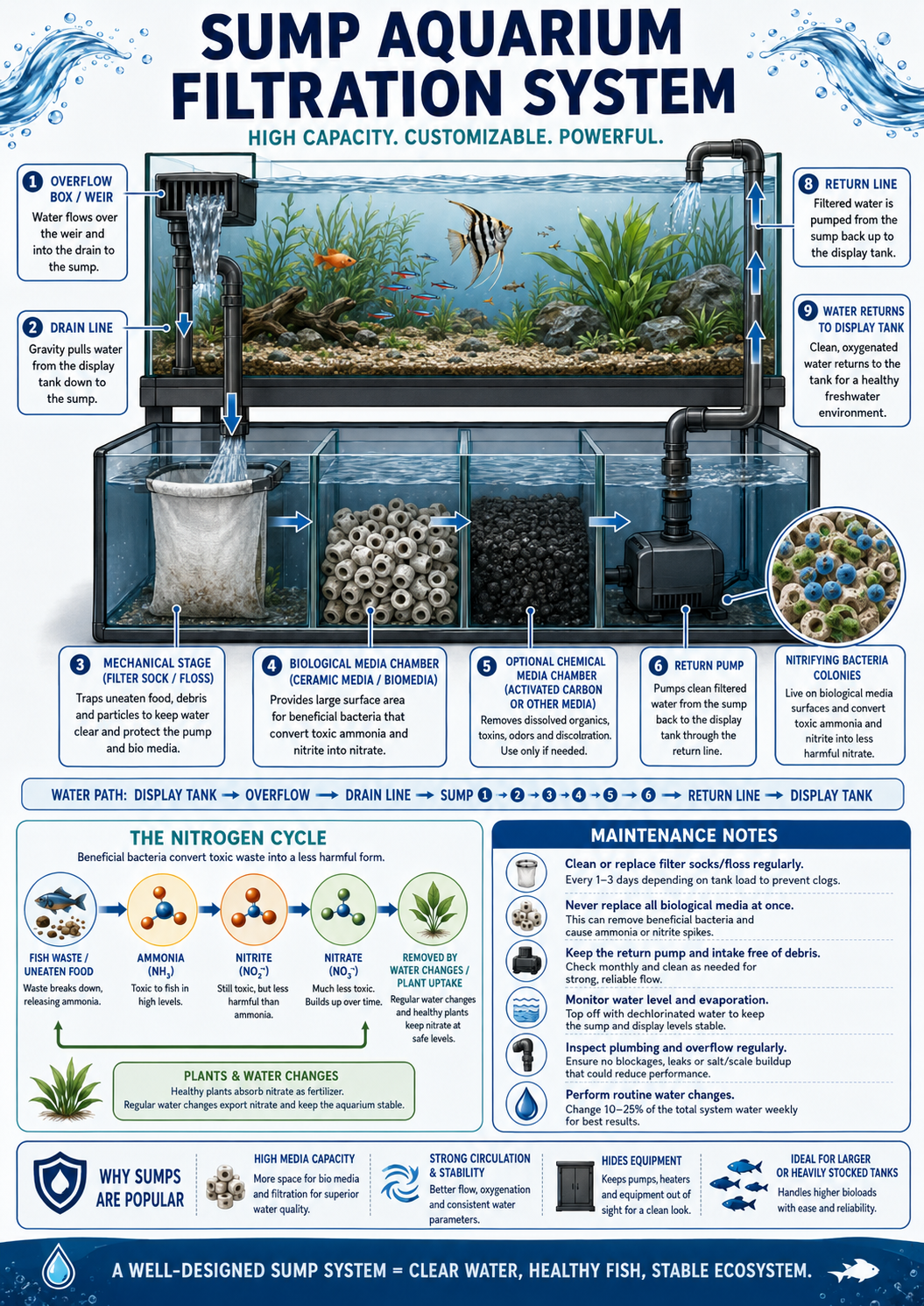
          Sump aquarium filtration system diagram for a planted freshwater aquarium Click to enlarge

          Sump Filtration

          Best for larger freshwater planted tanks, high bioload displays, reef tanks, and systems that need room for pumps, media, and hidden equipment.

          • Explains the full water path from overflow to drain line, sump chambers, return pump, and display tank.
          • Supports serious setup planning for plumbing, filter socks, ceramic media, carbon, pumps, and top-off habits.
          • Works as a general sump visual because the same plumbing idea can support freshwater, planted, or reef systems with different media choices.
          Water clarity support UV Sterilizer

          Best as a supplemental water-clarity and free-floating organism control tool for freshwater, saltwater, pond, and quarantine systems when matched to the right flow rate.
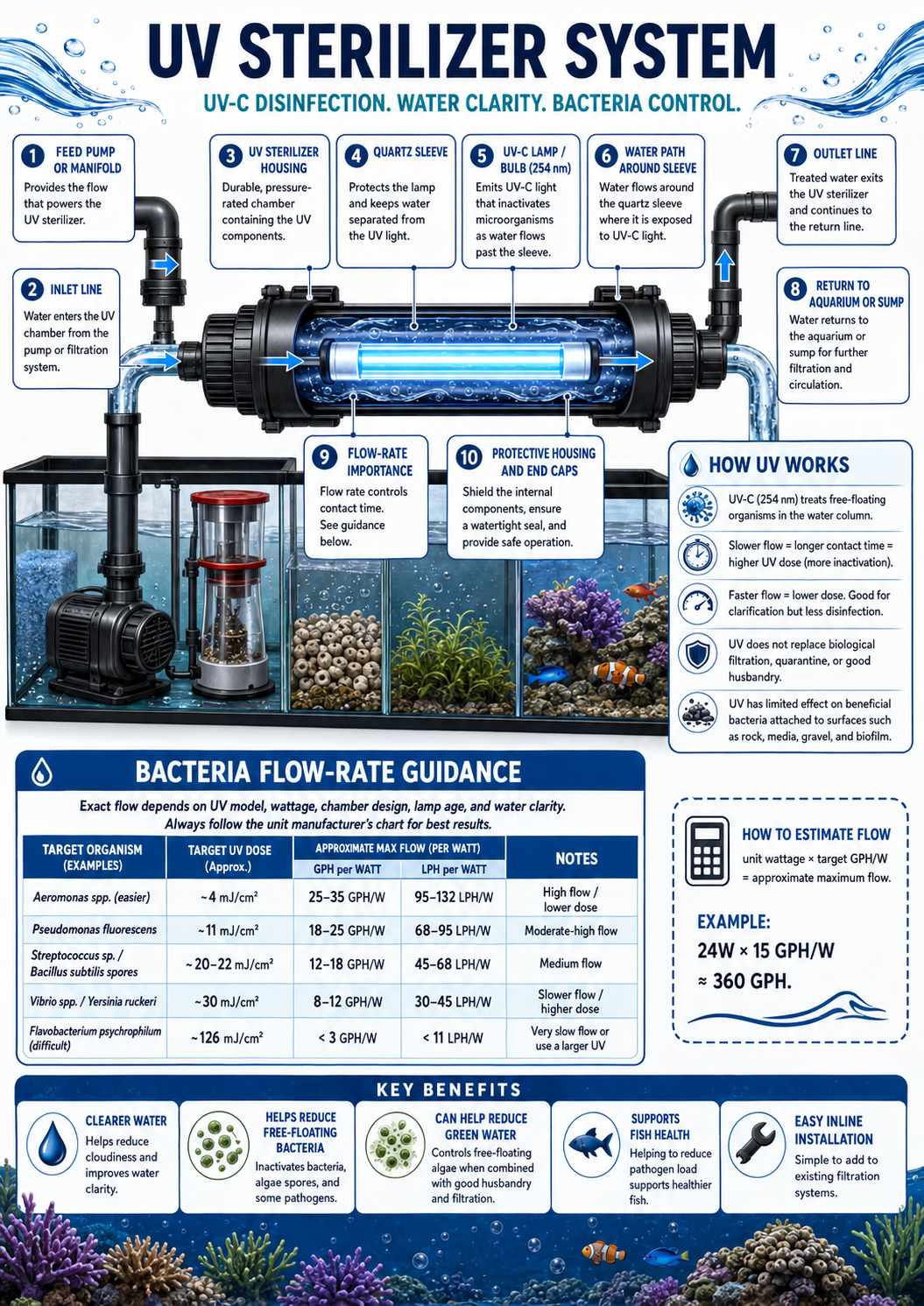
          UV sterilizer aquarium system diagram showing UV-C lamp, quartz sleeve, flow path, and return plumbing Click to enlarge

          UV Sterilizer

          Best as a supplemental water-clarity and free-floating organism control tool for freshwater, saltwater, pond, and quarantine systems when matched to the right flow rate.

          • Shows the feed pump or manifold, inlet line, UV housing, quartz sleeve, UV-C lamp, water path, outlet line, and return to the aquarium or sump.
          • Helps you compare UV wattage, replacement bulbs, pumps, tubing, flow control, and routine sleeve cleaning.
          • Clear husbandry note: slower flow increases contact time, but UV does not replace biological filtration, quarantine, or good maintenance.

          Saltwater & Reef

          Click a reef or saltwater system to compare live rock, sumps, reactors, skimmers, and compact all-in-one filtration.

          Natural biofilter Live Rock Biofiltration

          Best for reef aquariums where live rock is both habitat and a biological filter that supports bacteria, microfauna, and long-term stability.
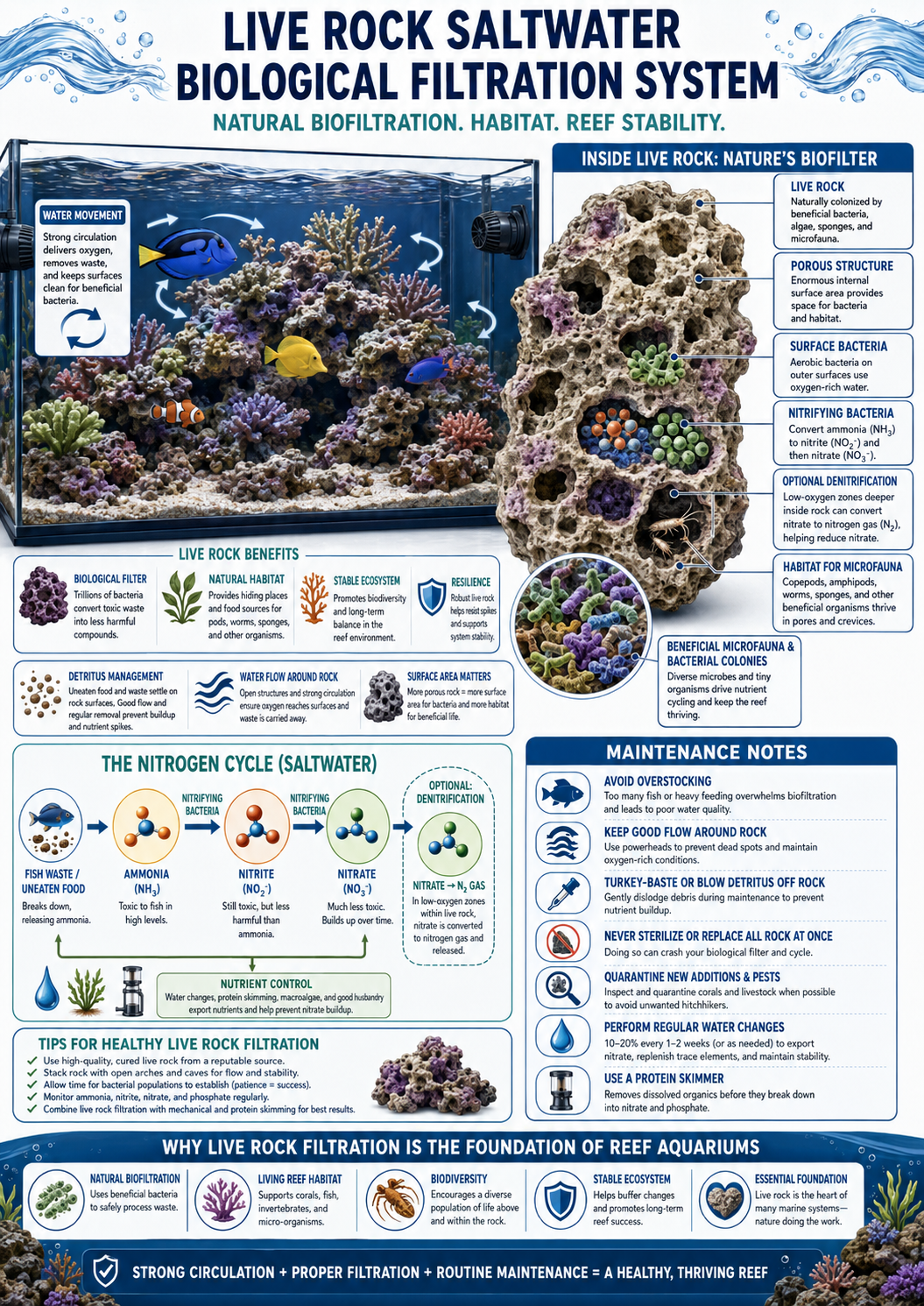
          Live rock saltwater biological filtration system diagram Click to enlarge

          Live Rock Biofiltration

          Best for reef aquariums where live rock is both habitat and a biological filter that supports bacteria, microfauna, and long-term stability.

          • Explains why porous rock, water movement, microfauna, and bacterial colonies all matter in a saltwater system.
          • Natural path for choosing live rock, reef-safe flow pumps, protein skimmers, saltwater test kits, and quarantine supplies.
          • Strong husbandry message: never sterilize or replace all live rock at once, and keep detritus from building up.
          Reef-ready sump Saltwater Sump

          Best for reef-ready tanks that need more water volume, cleaner equipment placement, protein skimming, refugium space, and stronger nutrient export.
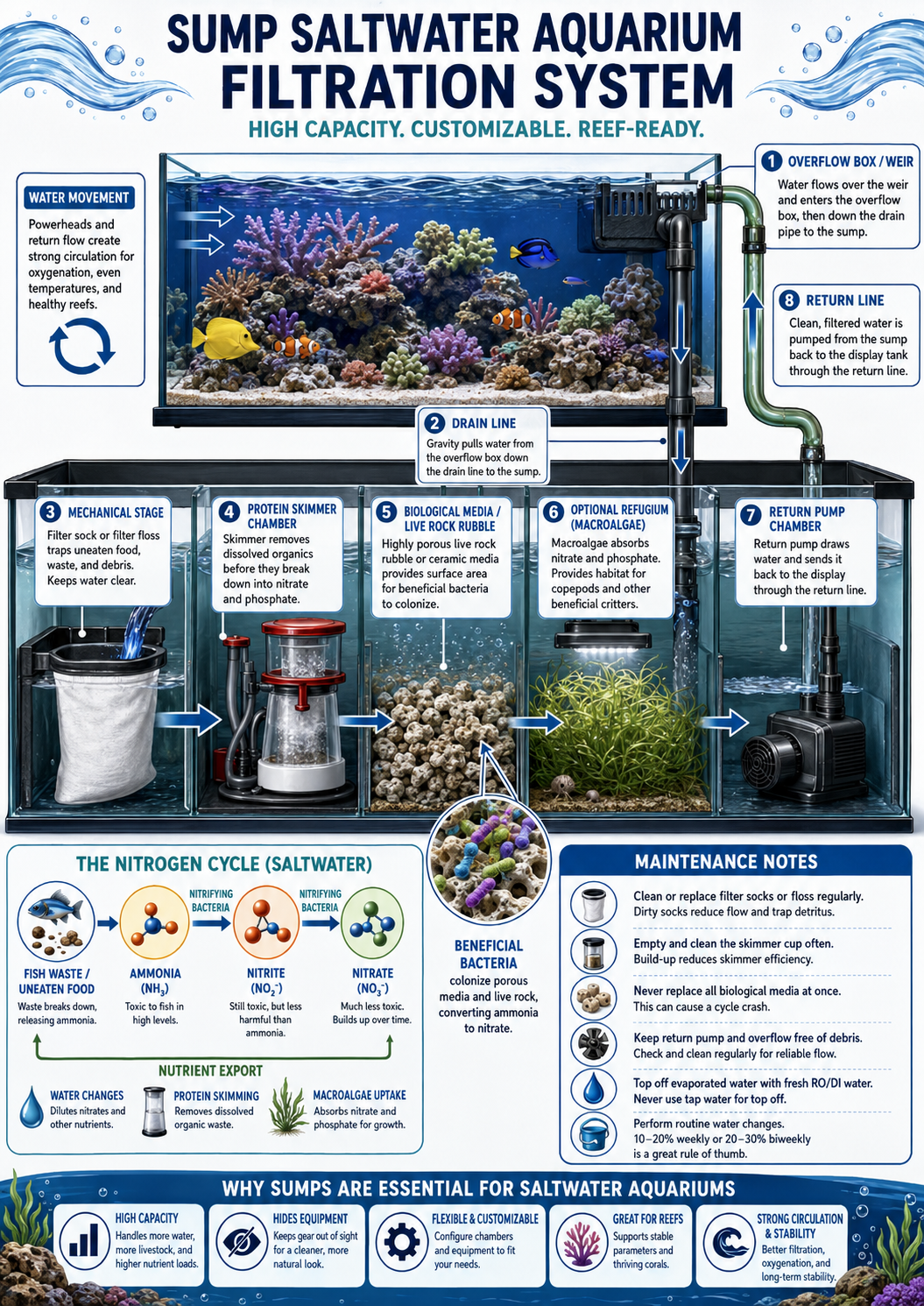
          Sump saltwater aquarium filtration system diagram Click to enlarge

          Saltwater Sump

          Best for reef-ready tanks that need more water volume, cleaner equipment placement, protein skimming, refugium space, and stronger nutrient export.

          • Shows the full reef water path: overflow, drain line, mechanical stage, skimmer, live rock rubble, refugium, return pump, and return line.
          • Helps you compare skimmers, socks, return pumps, macroalgae, live rock, and RO/DI top-off habits.
          • Good planning visual when you are moving from basic filtration into a serious reef system.
          Same HOB, marine use Using a HOB on Saltwater

          The filter body is not fundamentally different from a freshwater HOB. This guide shows how the same style of filter is used on small marine tanks, quarantine systems, nano reefs, hospital tanks, and fish-only saltwater aquariums.
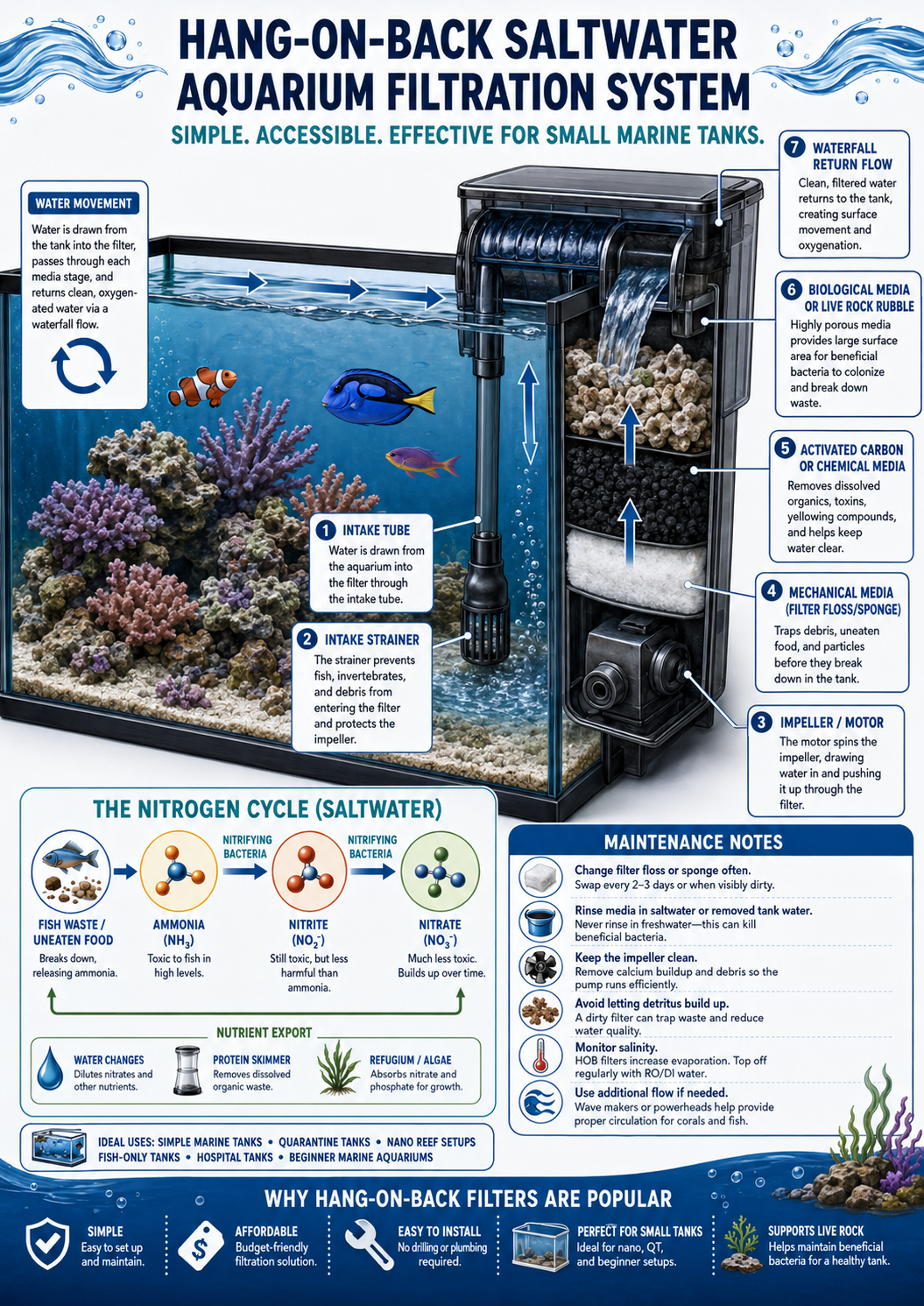
          Hang-on-back filter used on a saltwater aquarium diagram Click to enlarge

          Using a HOB on Saltwater

          The filter body is not fundamentally different from a freshwater HOB. This guide shows how the same style of filter is used on small marine tanks, quarantine systems, nano reefs, hospital tanks, and fish-only saltwater aquariums.

          • Shows intake, strainer, impeller, filter floss, carbon, live rock rubble, and waterfall return in one easy-to-follow layout.
          • Highlights saltwater-specific care: rinse media in saltwater or removed tank water, monitor salinity, and add flow when needed.
          • Useful bridge when you want marine filtration without drilling or plumbing.
          Nano reef setup All-In-One Saltwater

          Best for nano and medium reef aquariums where the display and filtration chambers are combined into one compact footprint.
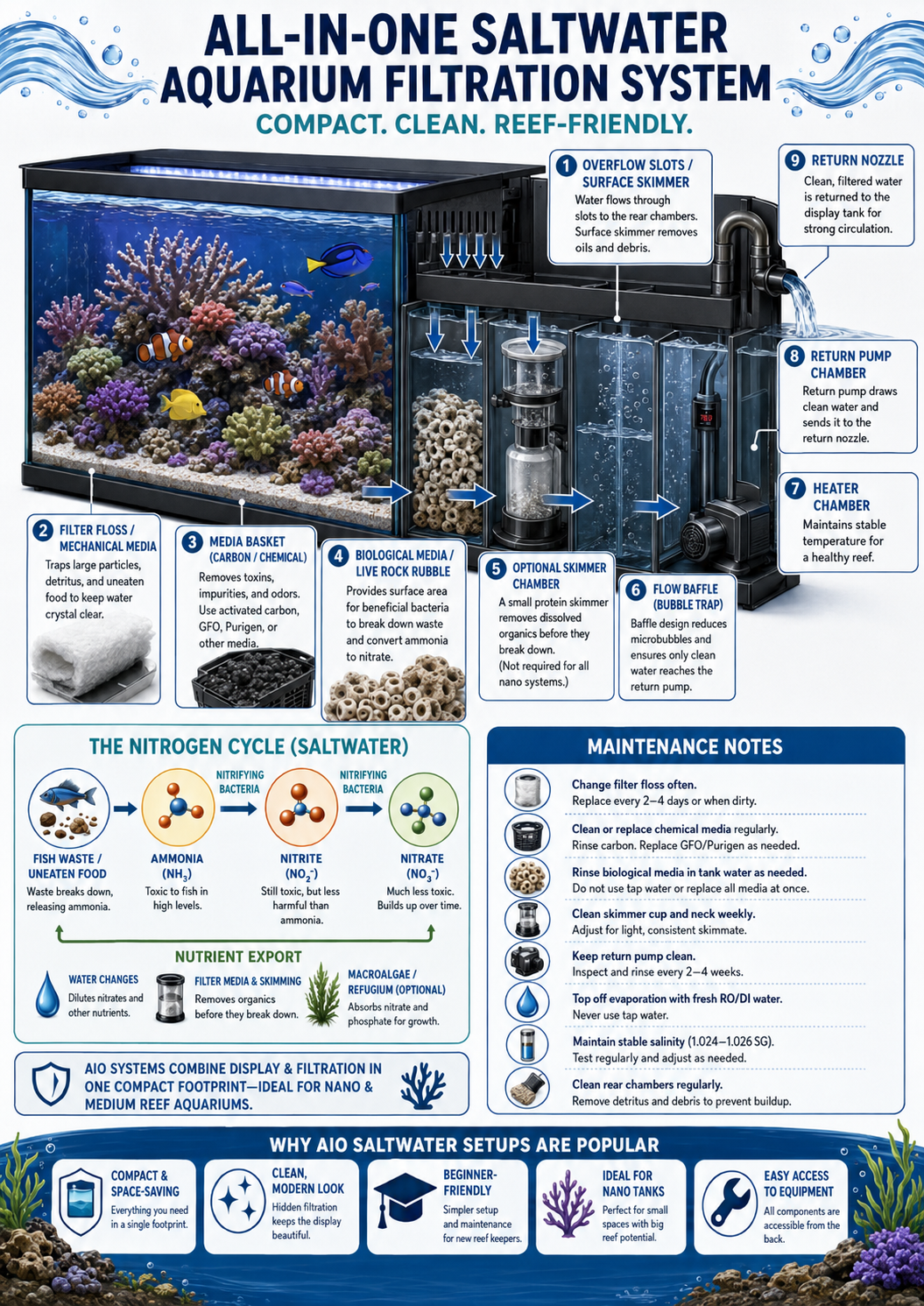
          All-in-one saltwater aquarium filtration system diagram Click to enlarge

          All-In-One Saltwater

          Best for nano and medium reef aquariums where the display and filtration chambers are combined into one compact footprint.

          • Explains rear-chamber filtration: overflow slots, filter floss, media basket, biological media, optional skimmer, baffles, heater, return pump, and nozzle.
          • Natural fit for nano reef kits, media baskets, floss, carbon/GFO, small skimmers, heaters, and return-pump maintenance.
          • Good beginner reef visual because it makes the hidden back chambers understandable.
          Targeted chemical media Media Reactor

          Best for reef and saltwater aquariums that need targeted phosphate, dissolved organics, or specialty media control with predictable flow.
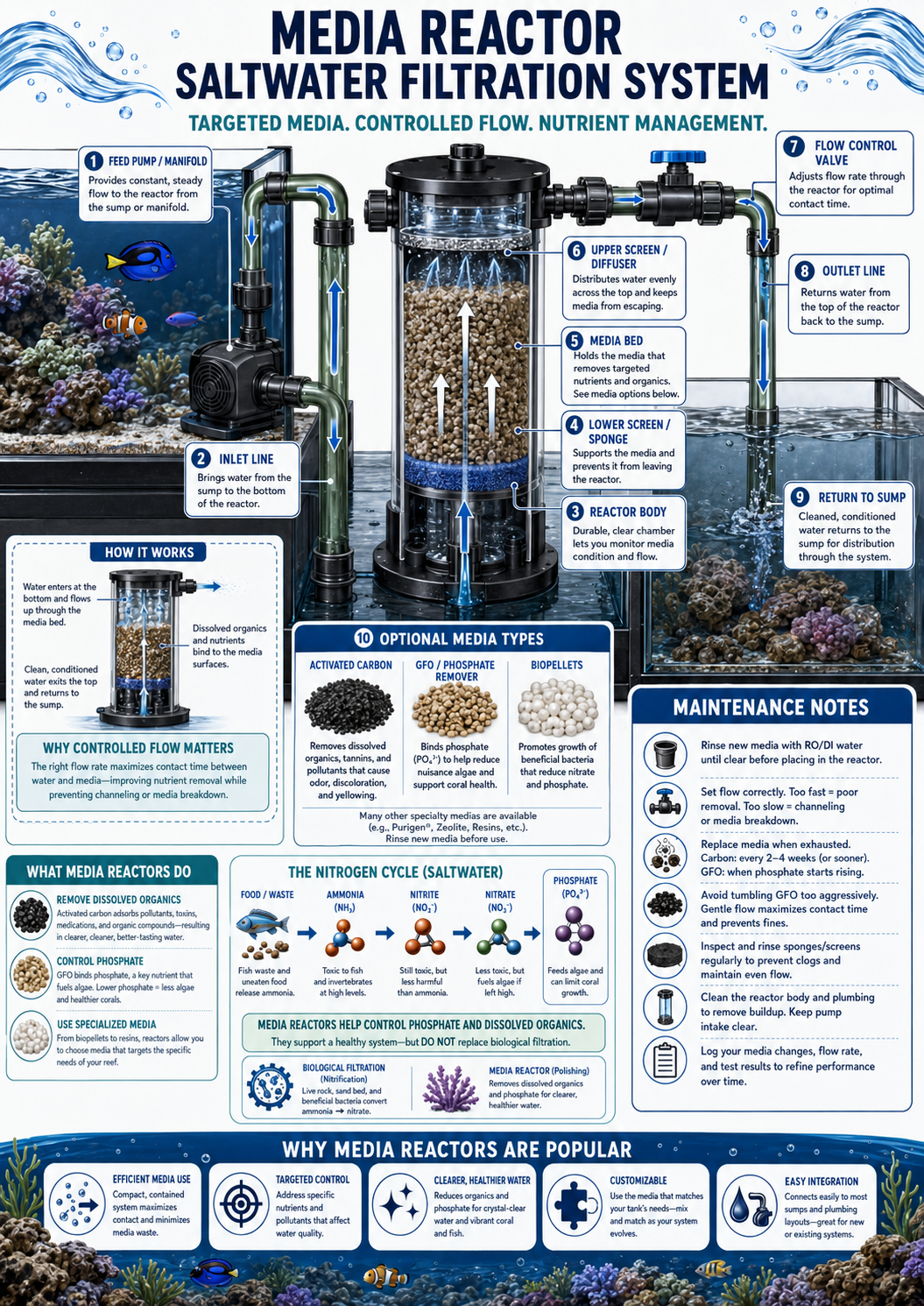
          Media reactor saltwater filtration system diagram Click to enlarge

          Media Reactor

          Best for reef and saltwater aquariums that need targeted phosphate, dissolved organics, or specialty media control with predictable flow.

          • Shows feed pump, inlet line, reactor body, lower sponge, media bed, diffuser, flow-control valve, outlet line, and return to sump.
          • Helps you compare activated carbon, GFO/phosphate remover, biopellets, tubing, valves, pumps, and replacement sponges.
          • Strong maintenance message: rinse media first, set flow correctly, avoid tumbling GFO too aggressively, and replace exhausted media.
          Nutrient export Protein Skimmer

          Best for reef tanks and saltwater aquariums where foam fractionation removes dissolved organics before they break down into nutrients.
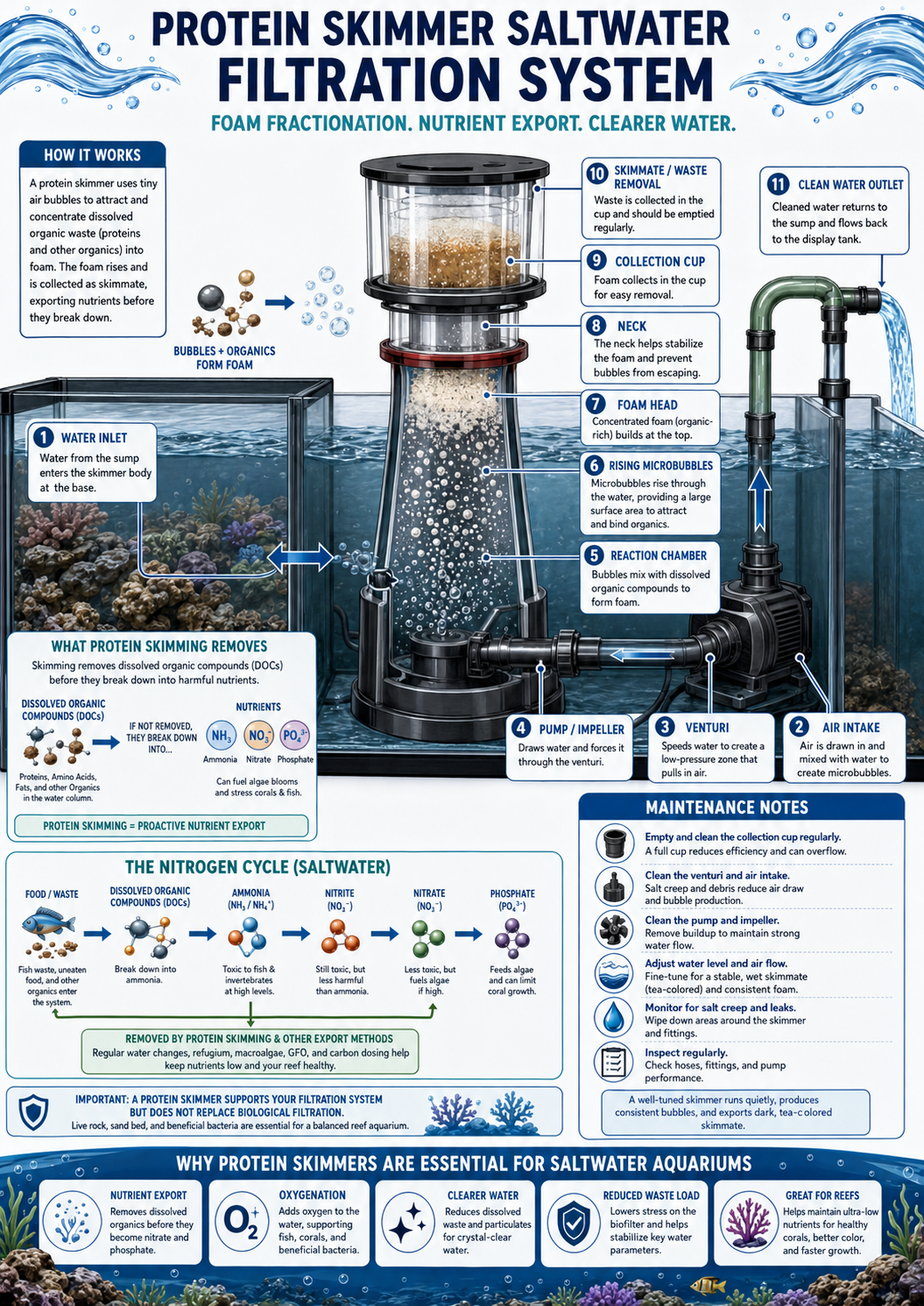
          Protein skimmer saltwater filtration system diagram Click to enlarge

          Protein Skimmer

          Best for reef tanks and saltwater aquariums where foam fractionation removes dissolved organics before they break down into nutrients.

          • Explains water inlet, air intake, venturi, pump, reaction chamber, rising microbubbles, foam head, neck, collection cup, and clean water outlet.
          • Useful for choosing skimmers, replacement pumps, air-intake cleaning tools, collection-cup maintenance supplies, saltwater test kits, and nutrient-control options.
          • Clear husbandry note: tune water level and airflow for stable foam, empty the cup regularly, and keep biological filtration in place.

          Food & Feeding

          Feeding guides, food types, and how to avoid common mistakes.
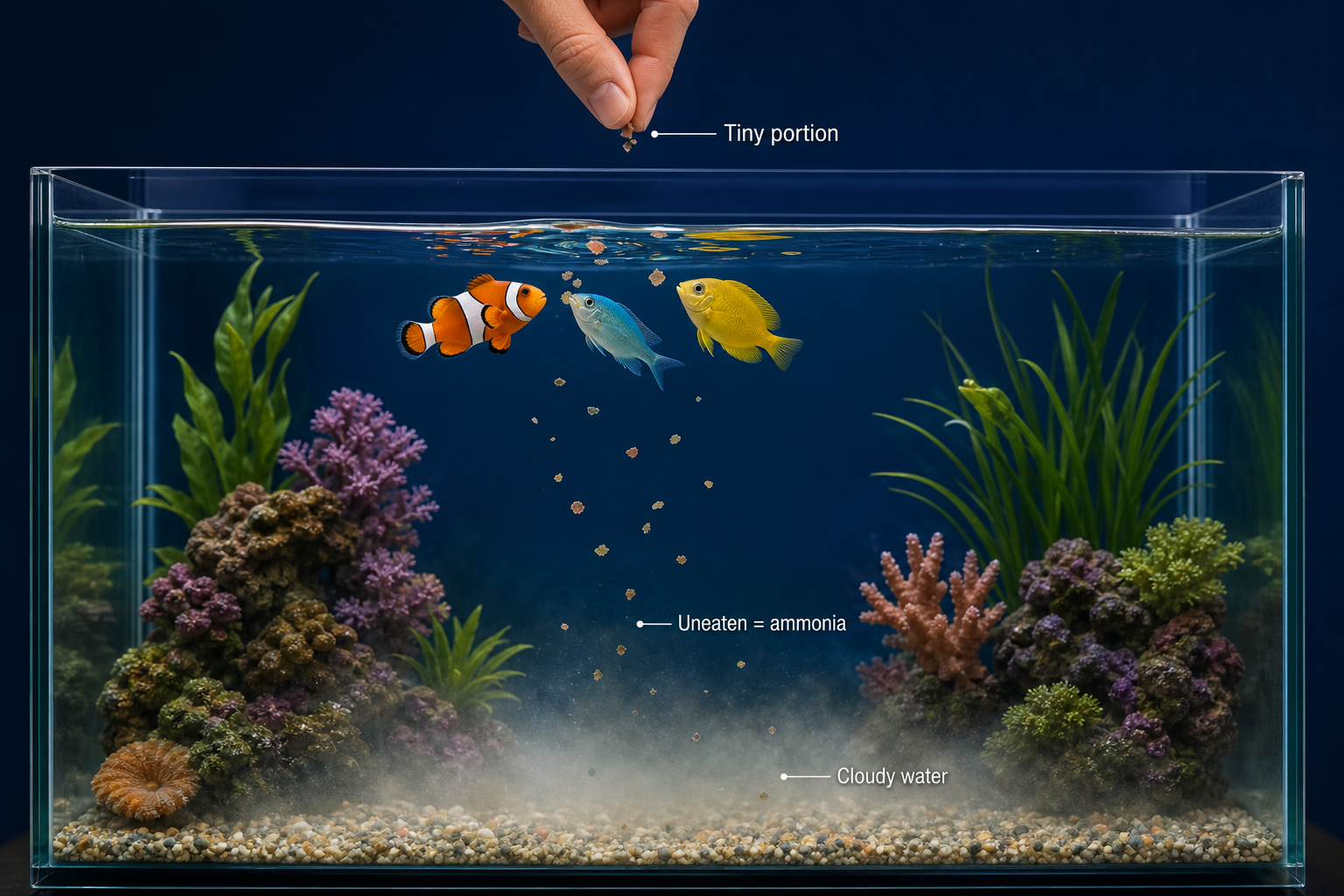
          Small aquarium feeding portion with uneaten food warning illustration Daily feeding

          Feed Less Than You Think

          • Most fish do better with small portions they finish quickly
          • Remove uneaten food before it breaks down into ammonia
          • Match food type to species, mouth size, and tank level

          Open portion guide

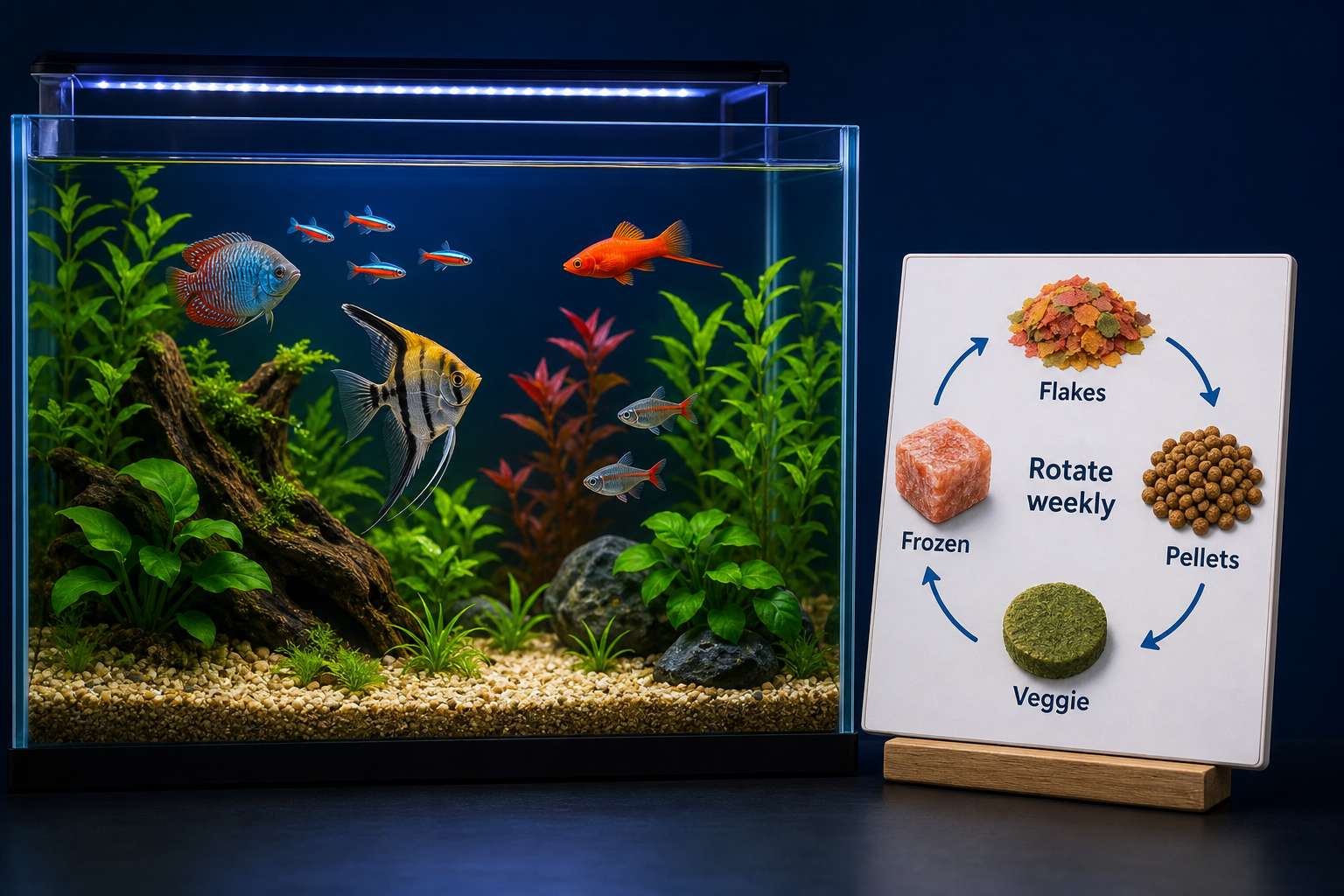
          Weekly aquarium food rotation schedule illustration Variety

          Rotate Food Types

          • Use pellets, flakes, frozen, and specialty foods where appropriate
          • Check herbivore, carnivore, reef, and pond needs separately
          • Watch body condition, behavior, and water quality together

          Open rotation guide

          Health & Water Quality

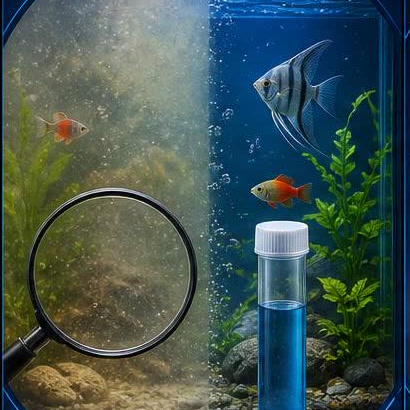
          Water testing, parameters, algae, parasites, and building a stable tank.
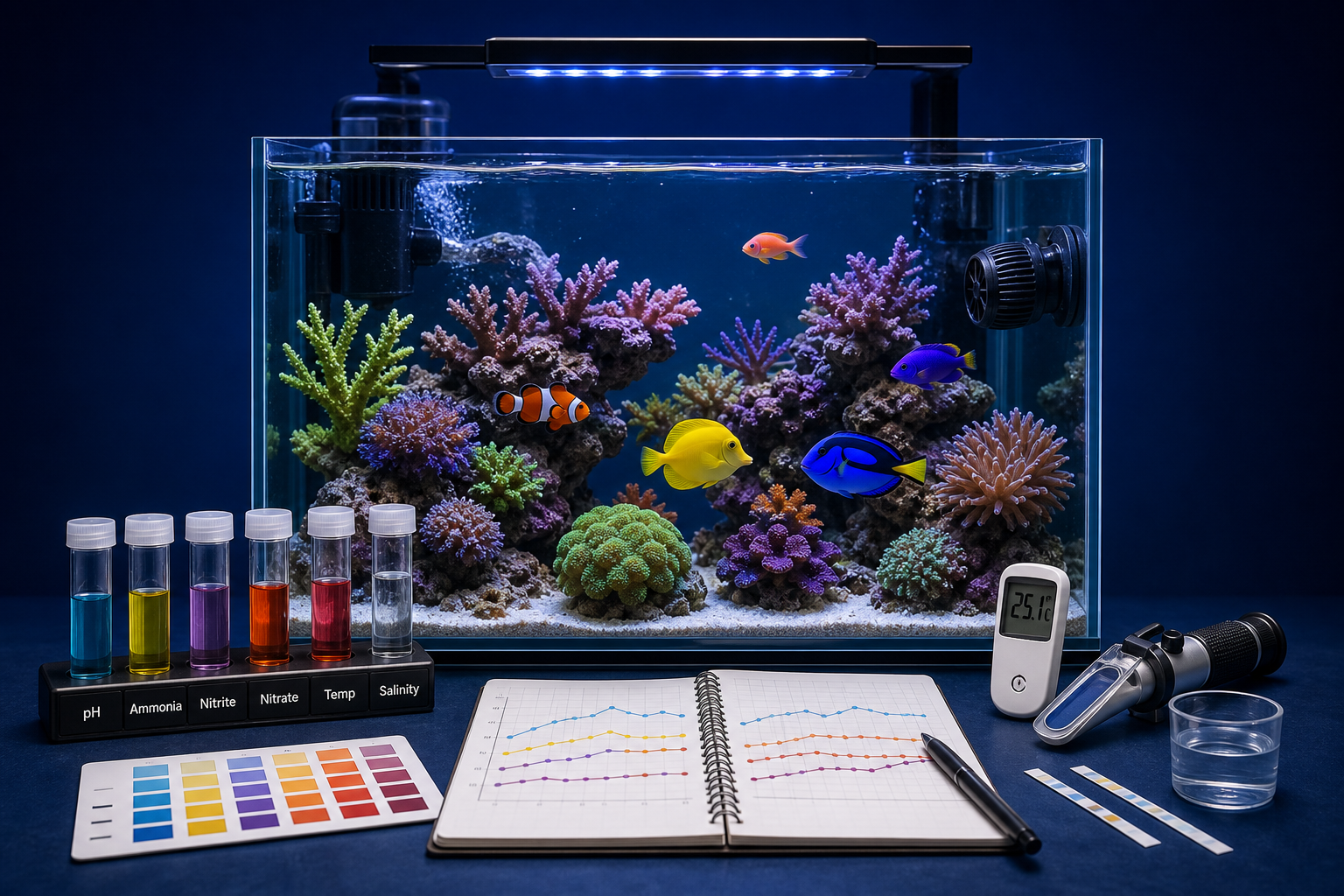
          Aquarium parameter testing dashboard illustration Testing rhythm

          Track Parameters

          • Test ammonia, nitrite, nitrate, pH, and temperature first
          • Use salinity, alkalinity, calcium, and phosphate for reef systems
          • React to trends instead of chasing one unusual reading

          Open guide

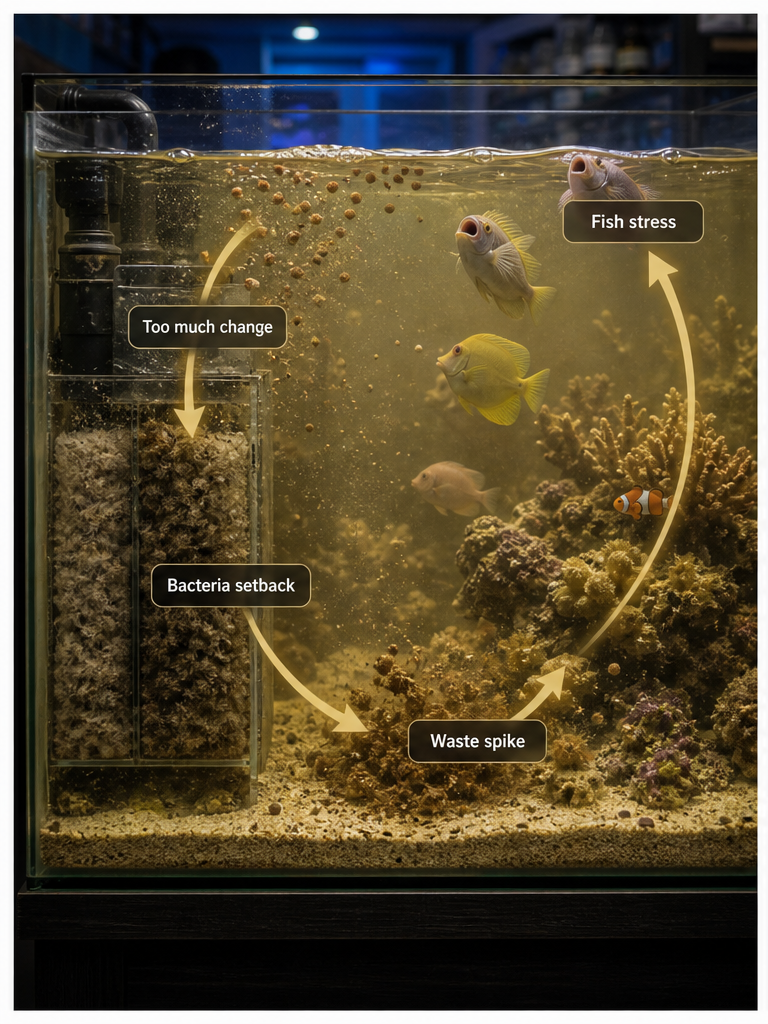
          Aquarium crash chain prevention illustration Stability

          Prevent the Crash

          • Keep biological media wet and avoid replacing everything at once
          • Do regular partial water changes matched to the system
          • Quarantine when possible and slow down major livestock additions

          Open guide

          Troubleshooting Center

          Diagnosis-style guides for the most common aquarium problems.

          Water clarity

          Cloudy Water

          Separate new-tank bacterial bloom, overfeeding, dirty substrate, filter problems, and green-water algae.

          Open guide
          Algae control

          Algae Taking Over

          Check light duration, nutrients, phosphate, maintenance habits, plant competition, and cleanup crew fit.

          Open guide
          Fish health

          Sick Fish & Parasites

          Spot symptoms like white dots, flashing, clamped fins, rapid breathing, fin damage, and appetite loss.

          Open guide
          Emergency

          Ammonia or Nitrite Spike

          Test immediately, protect livestock, reduce feeding, check filtration, and avoid replacing all media at once.

          Open guide
          Behavior clue

          Fish Gasping at Surface

          Prioritize oxygen, temperature, ammonia, nitrite, flow, surface agitation, and recent chemical additions.

          Open guide
          Reef stress

          Coral Not Opening

          Review salinity, alkalinity, nitrate, phosphate, lighting changes, flow, pests, and recent dips or moves.

          Open guide
          Green water

          Green Water Bloom

          Check light, direct sun, nutrients, filtration, water changes, and whether a UV sterilizer fits the system.

          Open guide
          Inverts

          Snails or Shrimp Dying

          Look at copper, ammonia, nitrite, parameter swings, acclimation, medication exposure, and missing minerals.

          Open guide
          Bad smell

          Tank Smells Bad

          Find hidden decay, clogged filters, dirty substrate, stagnant areas, dead livestock, and overfeeding before adding chemicals.

          Open guide

          Still not sure what is happening?

          Bring a fresh water sample, tank size, livestock list, recent test results, and clear photos of the tank or affected fish. That gives the store a much better starting point than guessing from one symptom.